This is a slightly edited version of an article that appeared in INTERPRETER RELEASES.
This reproduction has been made with the permission of the publisher of INTERPRETER RELEASES.
West Group (901 15th St., NW, Suite 1010, Washington, DC 20005, phone 202-337-7000)
Further reproduction or use without the permission of the publisher is prohibited
Interpreter Releases
PAPERS, PAPERS . .
.
PLEASE: A NATIONAL ID OR AN ELECTRONIC TATTOO?
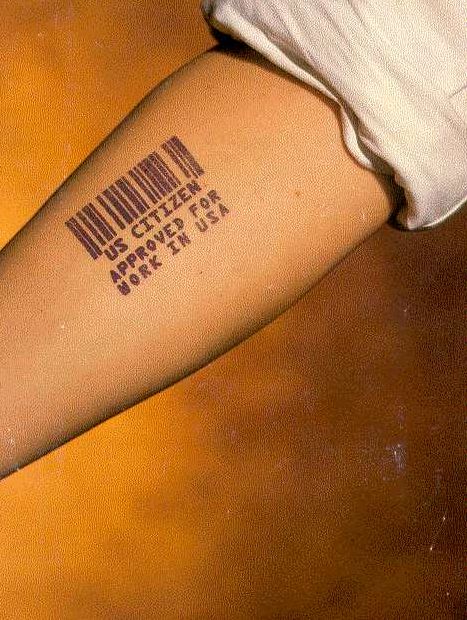
Andrew M. Strojny
[FNa1]
Copyright ©
1995 Federal
Publications Inc.; Andrew M. Strojny
Almost everyone
has
seen one of
those 1940s movies, set somewhere in
Identification
documents have
evolved over time to enable the holder not only to return home
from a
trip
abroad, but also to serve myriad other purposes. Today, many
different
documents are used to help establish the holder's eligibility
for many
types of
societal benefits, foremost among these the eligibility to
legally work
in the
Now under
serious
consideration
by Congress and the Clinton administration is a proposal, not
to create
a set
of papers or an internal passport, but to create a
computerized
national
registry of every man, woman and child authorized to work in
the
Background
In 1986, the
Immigration Reform
and Control Act (IRCA) made it unlawful, for the first time,
for all
employers
to knowingly employ an individual who was not authorized to
work in the
The U.S.
Commission on
Immigration Reform, chaired by former Congresswoman Barbara
Jordan, and
created
by the Immigration Act of 1990, recently examined how employer
sanctions were
working. In its 1994 report to Congress, it stated, "The
ineffectiveness
of employer sanctions, prevalence of fraudulent documents, and
continued high
numbers of unauthorized workers, combined with confusion for
employers
and
reported discrimination against employees, have challenged the
credibility of
current worksite enforcement efforts." [FN1] In plain English,
employer
sanctions are not working.
To solve the
problem,
the
Jordan Commission concluded "that the most promising option
for secure,
nondiscriminatory verification is a computerized registry
using data
provided
by the Social Security Administration (SSA) and the INS."
[FN2] The
nation's 5.5 million employers would then have access to the
registry
for
verification purposes. [FN3]
The employer
sanctions
provisions require a worker to produce an identity document if
he or
she uses a
social security card to prove work authorization--a document
combination the
Jordan Commission says is too easily counterfeited. Commission
representatives
recognized that as an option, a uniform national card showing
that the
holder
was in fact issued the social security number (SSN) being used
might be
required
to prevent fraudulent use of the number.
This proposal,
however,
was
immediately attacked as a call for a national identification
card. On
the same
day that Ms. Jordan announced the Commission's registry proposal,
a coalition of organizations ranging from the American Civil
Liberties
Union to
the conservative Cato Institute denounced the worker registry
proposal
as
unworkable, a threat to privacy rights, and at least a short
step away
from a
national ID. [FN4] Since then, the Commission has been busy
defending
its
proposal, and countering claims that the Commission is
endorsing a
national ID.
The political
controversy
surrounding such a card is best illustrated by the Jordan
Commission's
response
to the national ID charge. It denied that it had proposed any
such
thing, and
instead argued that it was merely going to propose requiring
that a
worker
provide an employer his or her social security number,
something that
has been
required for years for tax purposes. According to the
Commission, the
computer
would do the rest.
The Commission,
however, was
silent on how a worker was to prove that the social security
number he
or she
provided was in fact the number issued to him or her. In
various
forums,
Commission representatives suggested that such methods as a
mother's
maiden
name or a "PIN" [personal identification number] could be used
to
verify a SSN.
Over time it
became
clear that
mothers' maiden names and "PIN" numbers could be easily passed
around
with legitimate SSNs, thereby
rendering
that method
ineffective. Thus, it has subsequently been suggested that
perhaps even
a card
with a photo, fingerprint, or DNA encoding could be an option.
Because
this
again raises the specter of a national ID, the Jordan
Commission
appeared to many to have wound up
right
back where it started.
While the
charge of
creating a
national identifier packs an emotional wallop, there has been
little
real
discussion as to why it does so. Rather than engaging in
hyperbole, it
may be
useful to examine the concerns such a national identity card
or
computerized
registry raises. An initial examination yields three sets of
concerns,
some of
which overlap. There are practical implementation concerns,
governmental abuse
concerns, and privacy concerns. While there may be others,
only these
three
will be discussed in this article.
Practical Implementation
Concerns
In this new era
of
examining
what the federal government should be doing, it makes sense to
examine
or at
least raise the practical problems inherent in implementing
the Jordan
Commission's solution. There appear to be at least six.
The first
concern is
the cost
of issuing identity documents. According to some Social
Security
estimates, it
could cost upwards of $2 billion to issue
counterfeit-resistant photo
identity
cards to the entire population. This does not include the cost
of
issuing
replacement cards to people who lose them or of issuing
replacement
cards as
people age.
If our
political
leaders are to
be believed, the Social Security trust fund may go broke early
in the
next
century unless something is done. Adding at least $2 billion
to the SSA's expenditures does
not seem likely to help
fix the
solvency problem.
A second
concern is
whether
"one size identity card can fit all." Not everyone is
authorized to
work in the
Thus, the
belief that
the
Jordan Commission proposal will lead to a simple: "the
computer
says
you can work" or "the computer says you cannot work," is
false.
In many instances, as today's employers have already learned,
the
answer will
have to be "it depends."
A third concern
is the
cost of
using the computerized registry. It has been suggested that if
a
cashier can
determine whether a credit card is good merely by running it
through a
card reader,
the
A related
concern is
that the
government may not be as effective as MasterCard and Visa in
maintaining or
correcting databases. For example, in an ongoing INS pilot
telephone
verification system (TVS), 28 percent of the individuals
checked were
not in
the INS central database. [FN5] The majority of these
individuals
proved to be
work authorized. [FN6] This inaccuracy rate was 11 percentage
points
higher
than that found by a Justice Department audit in 1989. At that
time the
information in the INS database was incorrect or missing only
17
percent of the
time. [FN7]
While
inaccuracies in
INS
computer databases are legendary, the INS is not the only
agency with
such
problems. Some tests have found error rates of between five
and 20
percent in
some SSA databases. [FN8]
What happens
when the
government makes a mistake? For example, who will bear the
burden of
lost pay,
if the government erroneously states to an employer that
someone is not
authorized to work, when he or she in fact is? Given the
number of
employment
decisions made in any given year, it seems likely that there
will be a
large
number of times when the computerized registry or any manual
verification
system will wrongly state that someone is not authorized to
work. [FN9]
Given
current federal deficit problems, it seems unlikely that the
government
will
bear the burden, much less easily admit that it made the
mistake in the
first
place. Yet simple justice would seem to require that the job
applicant
not bear
the burden, if he or she ends up without a job merely because
of
government
error. [FN10]
More importantly, what procedures
will be
put in place for an individual to correct erroneous
information in a
database?
Anyone who has ever tried to correct erroneous information in
a credit
report
is aware of how important such procedures are and of the kinds
of
problems
inherent in utilizing them to correct wrong information. The
current
problems of
correcting entries in INS databases are well-known to many
immigration
law
practitioners.
This leads to
the
perhaps even
greater concern of what will be done to ensure that the
government and
employers do not disclose unauthorized information about
identity
number
holders. When the stakes are high enough (and even if they are
not),
the
government has not done a very good job at safeguarding such
information.
Safeguards concerning disclosure of State Department records
did not
prevent
disclosure of information about then-candidate Bill Clinton
during the
1992
presidential campaign. Also, newspapers have recently reported
instances where
Internal Revenue Service (IRS) employees were caught checking
the tax
returns
of famous taxpayers. It has also been reported that Social
Security
employees
have sold access to SSA information to private detectives and
credit
bureaus.
[FN11]
If the
government is
serious
about preventing unauthorized disclosure of information, it
could
require that
individual government and corporate employees be held
personally liable
for
such disclosure. The government could provide for criminal
sanctions,
civil
penalties, and punitive and compensatory damages.
A related
question is
how such
safeguards are to be enforced, if they are created. One of the
secrets
students
are taught in law school is that without a remedy, there is no
right.
If the
government says something shall be done, but does not provide
a remedy
when it
is not done, the right is worthless. In addition, who will
bear the
cost of the
attorneys necessary to utilize any remedies that are created?
A final
practical
implementation concern is the Jordan Commission's proposal to
tie its
national
registry to the SSN. In the past there has been little
incentive for
individuals to lie about such numbers. Originally the SSN was
the
equivalent of
a bank account number, into which deposits were made for an
individual's
retirement. A rational person would no more falsify an SSN so
their
retirement
deposits would go to another person's account than
intentionally make a
savings
deposit into a stranger's savings account. If SSNs
are to be used as the only way to establish permission to
work,
however, the
incentive to falsify the number greatly increases. Retirement
is a long
way
off; a pay check is at the end of the week.
Governmental Abuse
Concerns
As weighty as
the
practical
concerns of a national registry or identifier are, they are
not what
frighten
people most. Rather, it is the potential for governmental
abuse that
most
scares opponents of the Jordan Commission's proposal, and that
engenders the
most vehement feelings. That is what provokes the vague
allusions to
Nazi
Germany and identity number tattoos. It is why some have
dubbed the
national
registry proposal as analogous to an electronic tattoo.
The biggest
fear about
the
Jordan Commission's proposal is a conceptual one. It changes
the
relationship
between the citizenry and the government. Our Constitution
declares
that
"We the people" give certain powers to the government. Some
argue
that the Jordan Commission proposal stands that declaration on
its
head. It in
effect says that permission to work is another government
benefit
program with
the government deciding who is eligible. It creates a country
of "no
card,
no work" or, an even more frightening prospect, "if you're not
in the
computer, no work."
This is a
tremendous
amount of
power to give to the government--power that it has already
shown a
propensity
to use, at least in a limited immigration context. In May
1992, the INS
limited
the work authorization of certain classes of aliens to certain
states.
In hopes
of spreading Haitian refugees and asylum seekers around the
country,
INS
granted them documents limiting their authorization to work to
specific
states.
[FN12] It was hoped by some that the attempt to spread "them"
around
would keep down any political outcry that the influx of
Haitians might
provoke.
Since Haitians at the time were not a particularly politically
popular
group,
there was no outcry. Few saw any potential dangers, and the
limitations
did
help to convince the government to let the Haitians into the
country.
But what
happens when, for example, unemployment is too high in
The
government's
propensity to
use the limited power it already possesses in this area raises
"foot in
the door" fears that a national identity card or a national
registry
will
be used to satisfy popular political purposes. The fear is
that the
government
could use this power to punish political opponents, as tax
audits have
allegedly been used in the past. For example, relatives of a
third
party
candidate, a primary opponent, or a key Senate staffer might
suddenly
find that
the computer has "lost" their records and is reporting that
they no
longer exist.
There is
certainly no
shortage
of countries and governments around the world where lists of
various
sorts have
been used by a particular political entity to punish or
otherwise move
against
its opponents. Computerized lists make that task much easier
for such
governments.
A good illustration of this fear is the following news
release,
reporting on a
new practice in 1986 in
The Ugandan
Minister of
Internal Affairs announced that his ministry will soon start a
national
registration exercise. He said, “introduction
of the national identity card
will not only facilitate police and immigration work but also
will be
very
useful for other government agencies In Uganda there are
still
many
anti-government elements; the new measure of the ministry of
internal
affairs
may limit free movement of those elements.”
[FN13]
Any identity
card and
associated databases may be encoded with a variety of
information to
achieve
benign or perhaps even laudatory results. For example, one
could encode
a card
or computer file to show whether an individual had any drunk
driving convictions, thereby helping ensure that drunks do not
become
school
bus drivers or oil tanker captains. This method raises
legitimate
fears, however.
Once this encoding starts, it will be very hard to resist, and
it could
not
only be used for positive goals, but also for other purposes.
One can
easily
envision encoding race, gender, religion, age, and disability,
to help
achieve
affirmative action goals, or to target inappropriately
particular
classes of
persons. It is equally plausible to envision encoding health
data, such
as
blood types and drug allergies to achieve health goals. It
only takes a
small
additional step, however, to add HIV status to the card.
Finally, there
is a
fear that a
national identity card or computer registry check will be
required only
of
those who do not fit some employer's stereotype of what an
American
worker
looks and sounds like. In practical terms, this means
primarily members
of
minority groups that look or sound "foreign." The anger and
fear this
engenders was recently illustrated to the author by a
third-generation
American
of Hispanic heritage: "I'm a citizen and I don't need a damned
card to
prove
it."
Privacy Concerns
Once we get
past
practical
implementation concerns and government abuse concerns, we are
left with
privacy
concerns. The Jordan Commission's proposal envisions that
there will be
on one
database an individual's entire work history, and the system
will be
able to
spell out the employment history of any individual at a
moment's notice.
This makes many
people
nervous.
The fear is analogous, for example, to that of anyone having
access to
a list
of videos that you rented, and all that could imply (it's
embarrassing
to have
it known that you rented Debby Does Dallas when you're running
for PTA
president). It has happened before. In 1986, some news
organizations
obtained
lists of videos rented by Judge Robert Bork, who was in the
middle of a
tough
Senate confirmation battle for the U.S. Supreme Court. [FN14]
There is
a
similar concern about anyone knowing your entire work history.
Inevitably,
there is a
fear
that a national identity card or national computer registry
will be
used for
purposes other than merely verifying that an individual is
authorized
to work
in the U.S. During last year's debate on President Clinton's
health
care
proposal, for example, one of the proposals was to have every
individual carry
a national health care card, which was to have the
individual's entire
health
history encoded on it. It wasn't long before many began
speculating
that such a
health card could double as a national ID card. [FN15] Could
not the
same be
said about a card whose purpose is ostensibly only to verify
work
eligibility?
There is also a
belief
that a
national identity card or national registry will be used for
law
enforcement
purposes. For example, there is little doubt that if such a
national
system
were in place today and could prove useful in catching the
Perhaps all
this boils
down to
people just wanting to be left alone, to the idea that what we
do is no
one's
business but our own and we don't want our ability to keep our
own
business to
ourselves compromised. At a minimum, if the Jordan Commission
proposal
is
implemented, every person who works will be traceable, at
least more so
than he
or she currently is. It will be harder for one to be able to
just "get
lost." Undoubtedly, after the
One of the great differences
between free
and
enslaved societies is the right of the individual to live and
work
without the
government knowing his every move. There can sometimes be
privacy
without
freedom, as those in solitary confinement know, but there can
be no
freedom
without privacy. [FN16]
Conclusion
What does all this mean?
Where does
it
lead? No one is quite sure, but at a minimum we should realize
that
what is
under consideration is something fundamental. If carried out
to its
full
extent, the Jordan Commission's proposal has the potential to
alter the
relationship between the federal government and the people of
the
Editors' note:
The
In addition, legislative
proposals
in
Congress contain verification methods similar to the Jordan
Commission's
proposal. The bill most likely to move in
the near
future, S.
269, a comprehensive immigration bill proposed by Sen. Alan.
K.
Simpson
(R-Wyo.), contains a mandate to
test
verification
systems, along the lines of the Commission's proposal. [FN17]
[FNa1]. Andrew M. Strojny
practices law in
[FN1]. U.S. Commission on
Immigration
Reform,
"U.S. Immigration Policy: Restoring Credibility, A Report to
Congress," 1994 Executive Summary, at 12 (Sept. 1994)
[hereinafter
Commission Report]. See 71 Interpreter Releases 1345 (
[FN2]. Commission Report,
Executive
Summary at 12.
[FN3]. National
Law
Journal,
[FN4]. See 71 Interpreter Releases
1345 (
[FN5]. For more on the TVS, see 72
Interpreter
Releases 524 (Apr. 17, 1995); 71 Interpreter Releases 791
(June 13,
1994); 69
Interpreter Releases 702 (June 8, 1992); 515 (
[FN6]. 21
Immigration
Review 5
(Spring 1995).
[FN7]. 9 Immigration Policy &
Law 5 (
[FN8]. National
Law
Journal,
[FN9]. A one percent error rate in
a
universe of
over 100 million hiring decisions a year would affect over one
million
people.
[FN10]. Under IRCA in at least one
instance,
according to a Department of Justice press release, the Office
of
Special
Counsel for Immigration Related Unfair Employment Practices
settled a
charge
against an employer where the company "insisted on seeing a
document
issued by the INS...in order to
satisfy the
employer
sanctions provision of...IRCA." The alien "complied but still
was not
hired because the company then tried to doublecheck
the validity of the document with the INS which, in turn, gave
the
employer
erroneous information..." Department of
Justice
press
release no. 94-446, "Justice Department Settles
Discrimination Charge
Against Northwest Fishing Company,"
[FN11]. National
Law
Journal,
[FN12]. A May 1992 INS cable,
reprinted in
69
Interpreter Releases 709 (
[FN13]. XINHUA Overseas New
Service,
[FN14]. It was discovered that
there were
in fact
no embarrassing film rentals by Judge Bork.
[FN15]. New
York
Times,
[FN16]. New
York
Times,
[FN17]. For more on S. 269, see 72 Interpreter Releases 169 (Jan. 30, 1995).